
Battery Charging and Storage Containers
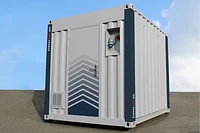
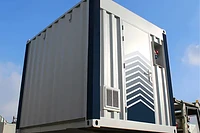
A battery storage container is a steel unit built for the storage and charging of lithium-ion batteries.
Each container is certified to a 60-minute fire rating and fitted with ventilation, racking, and alarm systems. Delivered ready to use, they can be deployed on sites where safe, compliant battery storage is required.
Key Features
- 63A single-phase power inlet
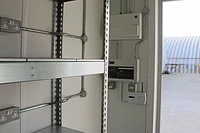
- Two charging circuits, each with 16 × 13A outlets
- PEN fault disconnector fitted (no earth rod required)
- Thermostat-controlled extraction fan, 530m³/hr airflow
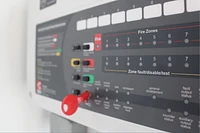
- Fire alarm panel with external beacon and GSM dialler for remote alerts
- Backup batteries keep the alarm system active during power loss
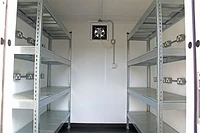
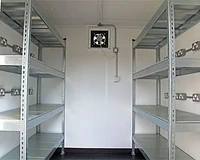
- Four-tier galvanised racking, 400kg load per shelf
Details
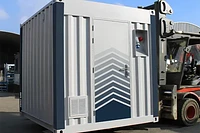
The units are constructed from fully welded mild steel with an anti-corrosive finish.
Corrugated panels protect against vandalism, and a reinforced steel door fitted with a ten-point locking system secures the unit against unauthorised access.
Inside, galvanised racking provides four adjustable tiers with a 400kg load capacity per shelf. This allows batteries to be stored safely in volume, while keeping the container organised and accessible.
Where battery storage units are used
Battery storage containers are used where lithium-ion batteries need controlled storage and charging.
On construction sites, they provide a safe place for tools and packs. In warehousing and logistics, they are used for forklift fleets and EV batteries, where proper ventilation and power capacity are essential.
Local authorities use them for equipment and e-vehicles, meeting compliance requirements across depots. They are also deployed on temporary sites and at events, where a relocatable unit can provide both charging and security without permanent facilities.
Safety features
- Certified fire protection – Each container is built to a 60-minute passive fire rating. This slows the spread of fire and provides time for evacuation or intervention.
- Automatic power isolation – Charging circuits disconnect as soon as the alarm is triggered, preventing further fault or escalation.
- Integrated alarm system – External beacon and sounder provide immediate warning, while a GSM dialler can send text alerts to nominated contacts.
- Backup operation – The alarm remains live during power failure thanks to onboard backup batteries.
- Controlled ventilation – A thermostat-controlled extraction fan delivers 530m³/hr airflow to keep conditions stable and reduce the chance of thermal runaway when multiple batteries are charging.
Lithium battery storage risks
Lithium-ion batteries are now standard in power tools, forklifts, vehicles, and renewable energy systems.
While efficient in use, they present significant hazards during storage and charging. If a cell overheats, the resulting fire is difficult to stop and can spread rapidly. Standard cabins and workshops are not designed for this, which creates a risk of fire moving through the rest of the site.
Insurers and regulators now expect lithium batteries to be stored in a controlled environment. A battery storage container provides this with fire-rated construction, ventilation, alarms, and automatic power isolation.
Why Cleveland Containers?
We supply specialised containers for sectors where standard storage is not enough.
Our battery storage units are built to meet strict fire-safety standards and can be delivered across the UK.
With a fleet of more than 4,500 containers and experience working with contractors, logistics operators and public bodies, we have the scale and knowledge to support projects that require compliant lithium battery storage.
Ready to order?
Contact our team today to discuss battery storage unit options for your site.
Let's get your container sorted
Get clear options, fast pricing, and straight answers.
FAQ
Each unit is fitted with two charging circuits, supplying 32 sockets in total. The internal racking system has a 400kg load capacity per shelf, giving space for multiple packs to be charged and stored at the same time.
The fire alarm panel includes backup batteries that need testing when the power supply is connected. It is also good practice to check the alarm system, beacon, and extraction fan as part of routine site inspections. We can advise on simple inspection steps to keep the unit operating safely.
Yes. Battery storage containers are built to standard container dimensions and can be transported and repositioned using conventional haulage whenever a project changes.
Insurers often ask for evidence of fire-rated storage when lithium batteries are kept in volume. These units are certified to a 60-minute fire rating and include safety systems such as automatic power isolation and alarms, which support compliance with insurance and health and safety expectations.