
Shipping Container Delivery Guide
A complete guide to shipping container delivery in the UK. Site prep, access requirements, foundations, and what to expect on the day.

Shipping Container Delivery: Everything You Need to Know
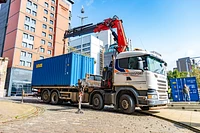
Cleveland Containers typically delivers shipping containers using crane-fitted HIAB lorries, positioning your container in the agreed location on site. Delivery requires a minimum access width of 12ft, level hardstanding ground, and clear overhead space. The ground must be prepared before the vehicle arrives.
This guide covers site preparation, foundation options, access requirements and what happens on the day.

Pre-Delivery Checklist
Before your container arrives, confirm the following are in place:
- Ground is level, firm, and hardstanding (concrete, tarmac, or compacted gravel)
- Access route is at least 12ft wide with no sharp turns
- Overhead space is clear on the route and above the placement site, with no cables
- Space on either side of the placement site for HIAB stabilising legs
- Area is clear of vehicles, materials, and debris
How We Deliver
Cleveland Containers delivers from 20+ depot locations nationwide, covering the full range from 8ft shipping containers to 45ft containers.
A delivery date is agreed at the point of order. Modified or bespoke containers may require additional lead time. We deliver to UK addresses only and cannot arrange international shipping.

Site Preparation
Site preparation is the single most important factor in a smooth delivery. An unprepared site is the most common cause of delay and additional cost.
Ground Conditions
The ground where the container will be placed must be level, firm, and stable. Suitable surfaces include concrete, tarmac, and compacted gravel. HIAB vehicles cannot drive over grass or soft ground. If your site is not hardstanding, resolve this before the delivery date is confirmed.
Clearing the Area
Clear all obstacles and debris from the delivery route and placement area before the vehicle arrives. This includes materials, vehicles, and equipment. If delivery involves a public road requiring a traffic management permit, arrange this in advance.

Foundation Options
A level, stable foundation ensures doors operate correctly and the container sits true from day one.
- Concrete base. The most durable option for permanent installations. Provides an even surface across the full footprint with minimal maintenance.
- Concrete blocks or flagstones. A practical alternative where a full base is not possible. Placed at each corner and at intervals along the length to distribute the load.
- Railway sleepers. Adjustable and suitable where ground level varies. Sleepers support each corner and can be stacked to achieve the correct height.
The container must sit level in all directions. An unlevel container affects door alignment and can compromise weatherproofing over time.

Access Requirements
HIAB vehicles are large and require adequate space to manoeuvre, extend stabilising legs, and operate the crane arm. Before confirming a delivery date, check the following:
- Minimum access width: 12ft for all gates, entrances, and narrow passages on the route to the placement site
- No sharp turns on the approach. HIAB lorries cannot navigate tight bends
- Clear overhead space on the delivery route and above the placement area. No branches, cables, or signs
- Leg extension space on either side of the vehicle. Must be clear and on firm ground
- No overhead cables above the container placement site
If your site does not meet these requirements, contact the team before booking. A smaller vehicle or alternative method may be possible but must be agreed in advance.

What Happens on Delivery Day
Understanding the delivery process helps you prepare your site and your team correctly.
- The HIAB lorry arrives and assesses the site. The driver checks access, placement area, and ground conditions before unloading.
- The vehicle is positioned and stabilising legs are extended. The lorry parks close to the placement site and legs are lowered to create a secure platform.
- The container is lifted and positioned. The crane arm lifts the container from the lorry and lowers it onto the foundation. Precise positioning is possible within the crane arm's reach.
- The container is released and checked. Once on the ground, the lifting equipment is detached. Raise any positioning adjustments at this point.
- You sign for the delivery. The driver retracts the stabilising legs and leaves the site.
Being present during delivery is strongly recommended. Repositioning after the driver has left requires a return visit.

Container Placement and Security
Placement. Position the container where doors can be accessed freely, water will not pool around the base, and the location remains practical through different seasons. Cleveland Containers recommends confirming the final position before the driver leaves, as repositioning requires a return visit.
Security. All new (one trip) Cleveland Containers units are supplied with a lockbox as standard, which protects the padlock from bolt cutter attack. For additional security, consider a closed-shackle padlock, CCTV, or perimeter fencing.
Modified and Bespoke Container Deliveries
Containers modified through Cleveland XTRAS or the bespoke conversions programme may have specific delivery requirements. Heavier units may need additional lifting capacity. Units with electrics need connecting to a power source on site after delivery. Raise any access or placement questions at the quoting stage. Requirements for modified units are confirmed at the point of order.
Reporting Delivery Issues
Any concerns after delivery, including stiff doors, visible damage, or unit condition, must be reported through our online support centre. Do not attempt to force stiff doors or make structural adjustments. Stiff doors are most commonly caused by an unlevel foundation and can usually be resolved by re-levelling rather than adjusting the doors directly.

FAQ
It is strongly recommended. Being present allows you to confirm the placement, answer any site access questions, and raise any issues before the driver leaves. If the container needs repositioning after delivery, that usually requires a return visit and an additional charge.
That depends on the width of the access route, turning space, overhead clearance, and the ground conditions on site. Standard HIAB deliveries need a clear route and enough space for the vehicle to stabilise and operate safely. If access is restricted, discuss the site with the team before booking delivery.
Not always. Final placement depends on how close the vehicle can get to the drop point, the crane's reach, the space needed for stabilising legs, and any overhead obstructions. If the exact position matters, confirm this with the team before delivery is arranged.
All issues including stiff doors, damage, or condition concerns must be reported through our online support centre. Stiff doors after delivery are most commonly caused by an unlevel foundation rather than a fault with the container itself.
Let's get your container sorted
Get clear options, fast pricing, and straight answers. Call free on 0330 005 5666 or get a quote and we'll confirm availability, lead times, and delivery requirements for your site.
You may also be interested in...
Next Steps Guide to Purchasing a Container
You’ve received your quote - now what? We make ordering a shipping container simple and stress-free, from confirmation to delivery.

The Importance of Enterprise Risk Management Systems
Find out how enterprise risk management can keep your employees safe and your business efficient all year round
How Much Does a Self-Storage Unit Cost?
If you are wondering how much a self storage unit costs, read our guide into factors that can influence the total price.